Skip to content
Stevan NapierThe Honest Surface Workshop

A practical restoration notebook

Know when to clean, repair, or replace the surface

Before you scrub harder or cover a failed joint, make one small test. I will show you how to read grout, caulk, shower glass, and finished hardwood, then choose the next action the surface can support.

First Low-Risk Test

PDF

61 pages · 8 chapters

Stevan Napier
The Bathroom & Hardwood Restoration Notebook

61-page PDF · 8 chapters

61Pages
8Chapters
$19Your order

The book

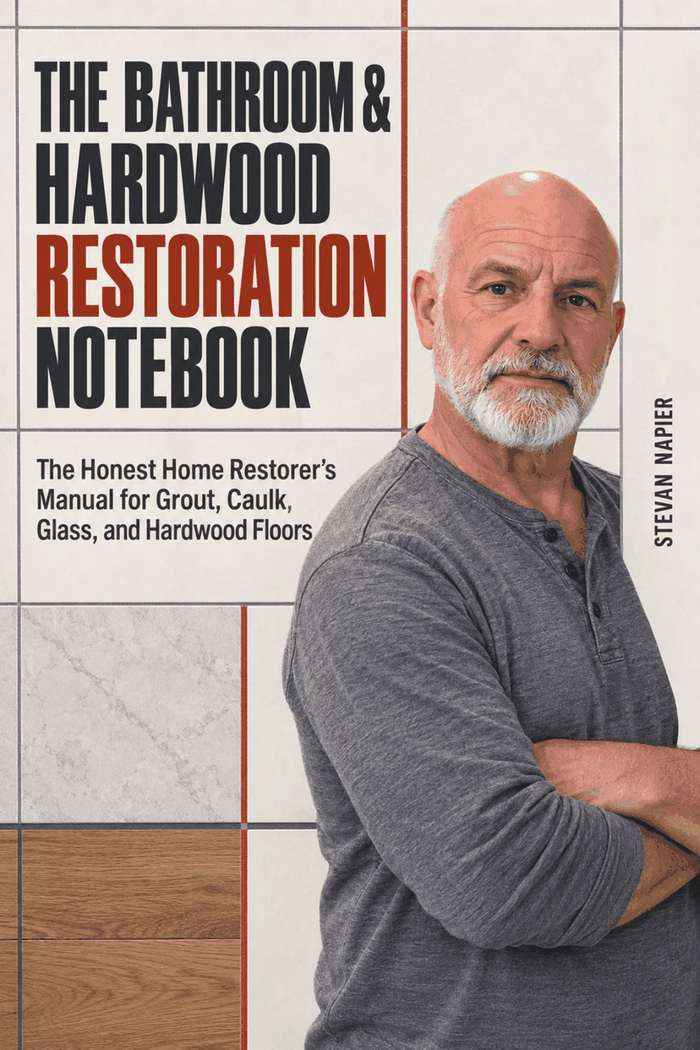
The Bathroom & Hardwood Restoration Notebook

The Bathroom & Hardwood Restoration Notebook

The book / 01

The Bathroom & Hardwood Restoration Notebook

The Honest Home Restorer's Manual for Grout, Caulk, Glass, and Hardwood Floors

Make the least aggressive test that can tell you whether the next job is cleaning, repair, monitoring, or replacement.

The Bathroom & Hardwood Restoration Notebook is a 61-page field manual for household surfaces that are difficult to read. It begins by separating soil, protective finish, and underlying material, then applies that diagnosis to cement grout, caulk, shower glass, dull hardwood, and scratches. You will use small test areas, angled light, water response, touch, and careful comparison before choosing a cleaner or repair. Later chapters cover complete caulk removal, compatible replacement, cure time, floor-film diagnosis, scratch depth, and the final restore, monitor, or replace decision. The book contains 8 chapters.

Selected chapters

  1. Start With the Surface You Actually Have
  2. Grout Is a Porous Joint, Not a Tile
  3. Caulk Has a Shorter Life Than Grout
  4. Shower Glass: Mineral Film or Etched Damage?
  5. A Dull Hardwood Floor Is Often Wearing a Film
  6. Scratch Repair Depends on Depth
  7. What Lasts: Preparation, Compatibility, and Cure
  8. Restore, Replace, or Leave It Alone
The Honest Surface Workshop

The mark you see is not always the damage you have

A cloudy, dark, dull, or cracked surface can point to several different jobs. The first useful move is to separate residue from finish failure and material damage.

  • A grout joint stays dark after scrubbing because dirty water has soaked into the porous cement instead of being lifted away.
  • A shower-corner bead looks stained, but a light fingertip press reveals a loose edge that needs complete removal rather than more bleach.
  • A glass panel remains cloudy after washing, leaving you unsure whether mineral scale is still on top or the glass itself has been etched.
  • A hardwood floor loses its clarity, and another coat of shine product risks adding film over traffic haze or worn finish.

Selected chapters

Three places to begin with the surface in front of you

You can read from the first diagnosis onward or enter through the chapter that matches today’s job. Each route begins with an observable test rather than a stronger product.

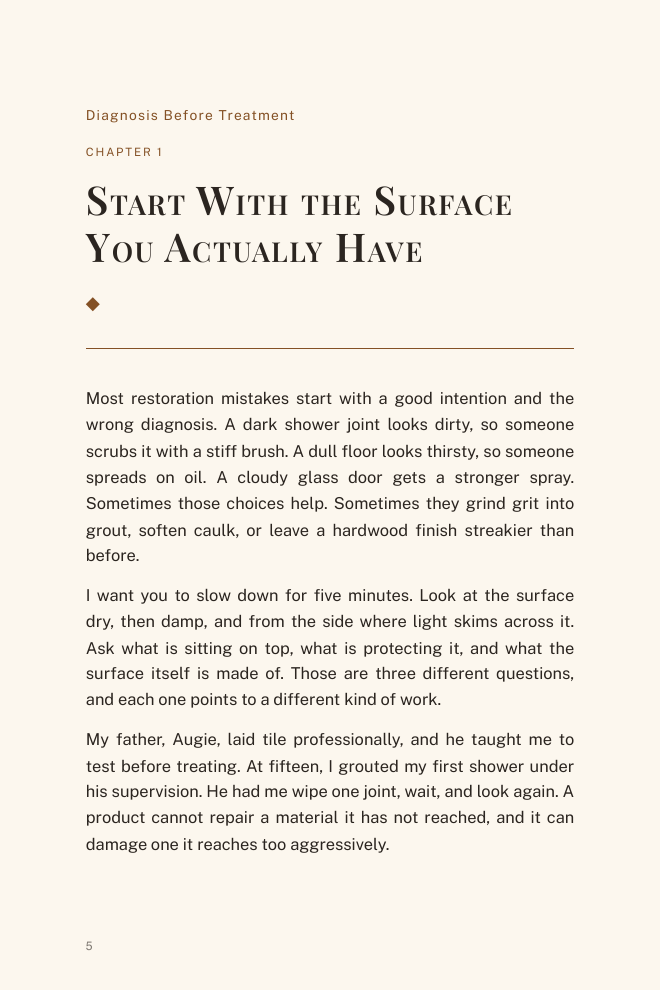
  1. Start With the Surface You Actually Have

    Inspect the area dry, then damp, and hold a light low across it. Separate what is sitting on top from the finish or seal and the material underneath before treating anything.

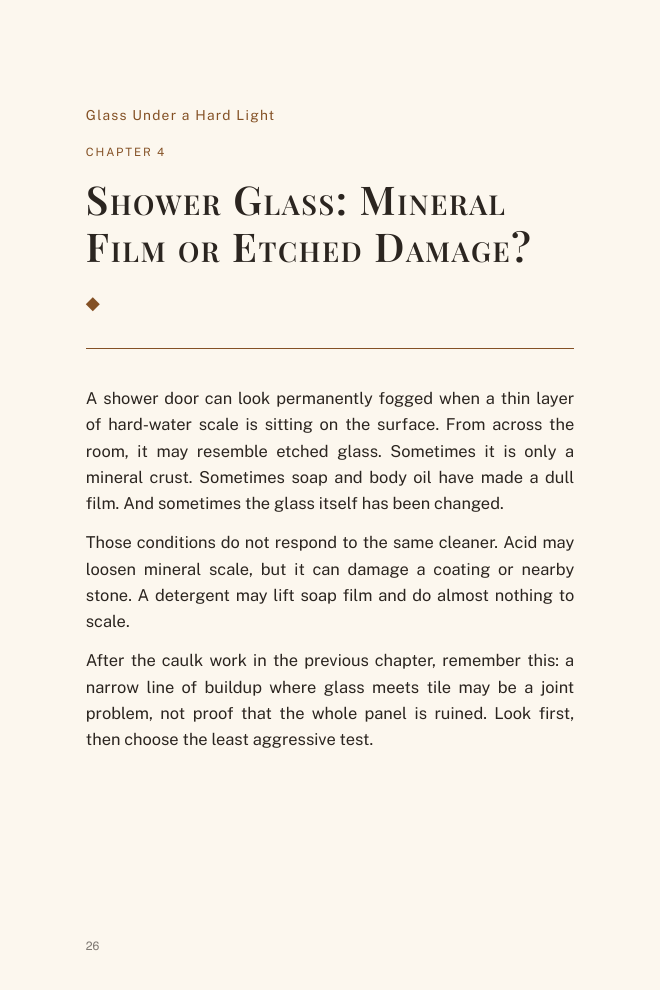
  2. Shower Glass: Mineral Film or Etched Damage?

    Choose one small corner. Try plain water and a soft cloth, test a compatible descaler if needed, rinse fully, and inspect under angled light before escalating.

  3. Restore, Replace, or Leave It Alone

    Take what you observed and place the condition on an honest path: restore it, monitor it, or replace it. Use the closing field rules to record what changed and what did not.

Look inside

Open a page and inspect the method

The page samples show the book’s workshop approach: ruled specifications, diagnostic comparisons, numbered figures, test sequences, warnings, and direct stopping points. You can also inspect the cover, Stevan’s portrait, and illustrative reader scenes before choosing the PDF.

61 pages · 8 chapters

Page 5 — Start With the Surface You Actually Have
Page 5 — Start With the Surface You Actually Have ↗
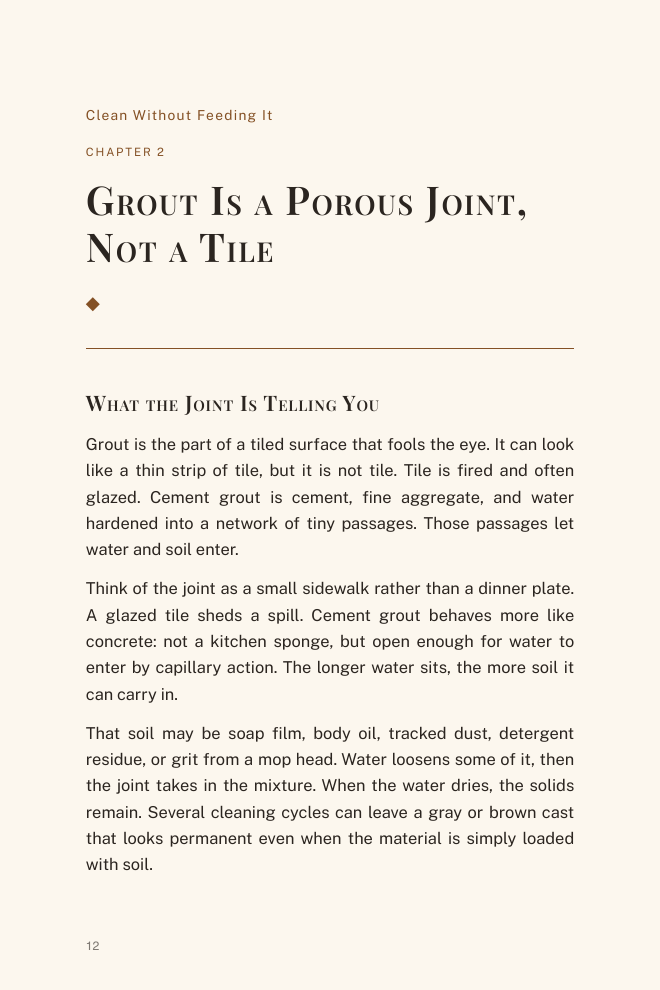
Page 12 — Grout Is a Porous Joint, Not a Tile
Page 12 — Grout Is a Porous Joint, Not a Tile ↗
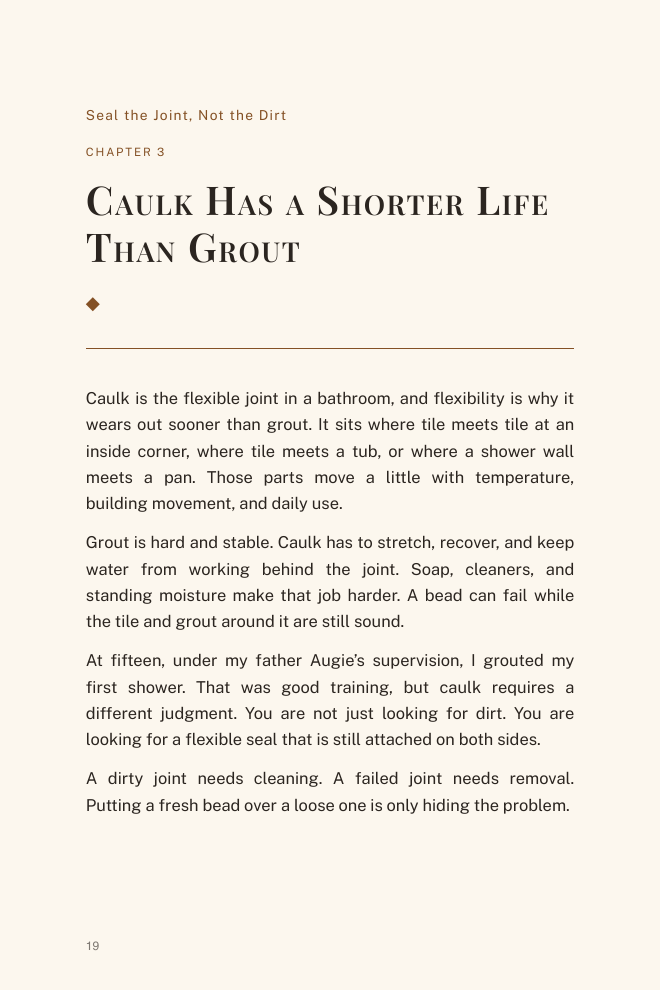
Page 19 — Caulk Has a Shorter Life Than Grout
Page 19 — Caulk Has a Shorter Life Than Grout ↗
Page 26 — Shower Glass: Mineral Film or Etched Damage?
Page 26 — Shower Glass: Mineral Film or Etched Damage? ↗
Stevan Napier

From the author

I learned to look twice before treating a surface

My father, Augie, laid tile professionally. When I grouted my first shower at fifteen, he had me wipe one joint, wait, and look again before carrying on. That habit still matters in the homes where I work: a dark joint may be dirty, wet, open, or crumbling, and those conditions do not call for the same bottle or brush.

I grew up with an avocado-green bathroom and helped my mother, Rosalind, polish the hallway floor in socks. She called me her buffing machine. These days I work on grout, shower glass, and hardwood floors, and I film from a bright tiled bathroom. Lorraine and my granddaughter keep life practical, and viewer comments help me decide which everyday surface problem to explain next.

— Stevan Napier

This is for you if

Who I wrote this for

This is for you if

  • You have grout, caulk, shower glass, or finished hardwood in front of you and want to diagnose it before buying another treatment.
  • You prefer small test patches, plain observations, and clear stopping points over dramatic cleaning shortcuts.
  • You want a compact reference that explains preparation, material compatibility, cure time, and routine maintenance.
  • You are willing to let a cleaned joint, tested pane, or dampened mark dry before deciding what changed.

What you get

The complete workshop notebook

You receive The Bathroom & Hardwood Restoration Notebook as a 61-page PDF with 8 chapters. It is built around the First Low-Risk Test approach, carried through grout, caulk, shower glass, hardwood and the final restore, monitor or replace decision.

The Bathroom & Hardwood Restoration Notebook

Your order

The Bathroom & Hardwood Restoration Notebook

$19

61-page PDF · 8 chapters

$19 USD · 7-day money-back guarantee

61 pages · 8 chapters

  • The Bathroom & Hardwood Restoration Notebook · 61 pages · PDF
Get the PDF $19

PDF

What you can work toward

What you can work toward

AI-generated illustrations of potential readers.

Stop feeding dirty water into grout

Learn why cement grout absorbs, how to lift dirty solution instead of moving it along the joint, and why the grout must dry before you judge the result.

AI-generated illustrations of potential readers.

Replace a failed shower joint properly

Compare bonded caulk with cracked, shrunken, or peeling material, then follow the sequence of complete removal, cleaning, drying, compatible replacement, tooling, and cure.

AI-generated illustrations of potential readers.

Read dullness and scratches before adding product

Use hidden areas, low-angle light, moisture response, and scratch depth to distinguish removable floor film from finish wear and exposed wood.

AI-generated illustrations of potential readers.

Companion books

Complete the set

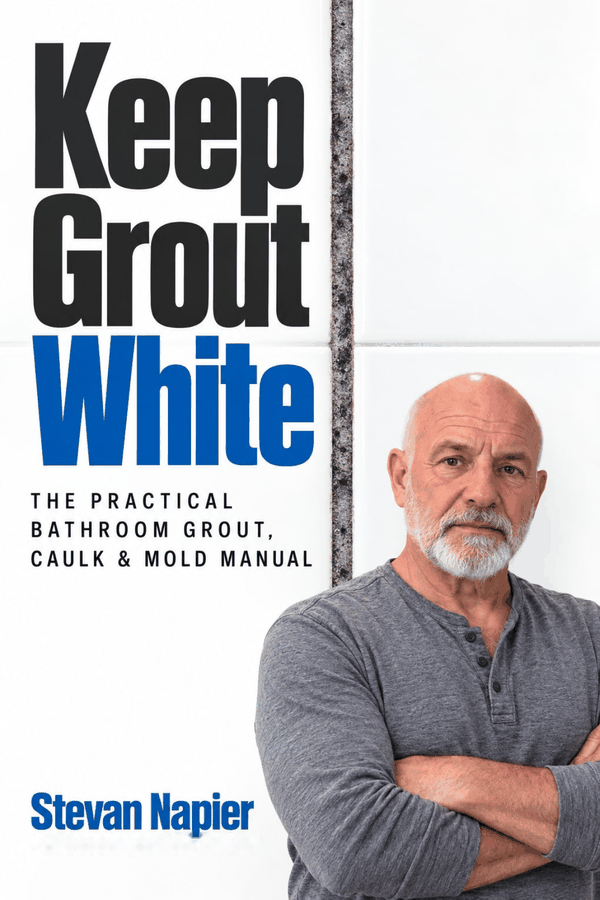
Keep Grout White

Companion book

Keep Grout White

A bathroom grout, caulk and mold manual that starts by telling dirt, moisture, mold and failed material apart. It then covers cleaning what can be saved, replacing failed caulk, repairing and sealing grout, drying the room faster, and a fifteen-minute weekly reset.

Hardwood Floor Care for Life

Companion book

Hardwood Floor Care for Life

A handbook for diagnosing, repairing and protecting hardwood floors. It covers identifying the finish, telling dull from dirty from worn through, choosing screen-and-recoat or a full sand, repairing scratches and water damage, and protecting the traffic lanes.

The Honest Surface Workshop

Questions

Do I need restoration experience to use the book?

No prior trade experience is assumed. The book starts with dry inspection, small test areas, plain water, soft tools, touch, and angled light so you can gather evidence before choosing a treatment.

Which surfaces does the notebook cover?

It covers cement grout, caulk, shower glass, dull finished hardwood, and hardwood scratches. It also addresses preparation, compatible materials, cure time, maintenance, and the decision to restore, monitor, or replace.

How is the book organized?

Eight chapters: start with the surface you actually have, then grout, caulk, shower glass, dull hardwood, scratch repair, what lasts (preparation, compatibility and cure), and a closing restore, replace or leave-it-alone decision. Each one begins with the least aggressive test that can tell residue from real damage.

Will it help me tell dirty caulk from failed caulk?

Yes. The caulk chapter compares surface discoloration with cracking, shrinkage, peeling edges, open corners, and movement under light fingertip pressure. It then lays out complete removal, drying, replacement, tooling, and cure.

Does it explain cloudy shower glass?

Yes. The glass chapter separates mineral scale and soap film, which sit on top of the glass, from etching, which changes the surface itself. The test path uses water, a soft cloth, a compatible descaler, complete rinsing, and angled light.

What does it say about dull hardwood floors?

The hardwood chapters compare removable product film, traffic haze, finish wear, and wear-through to wood. They also use water response, a fingernail check, and visible bare wood to route scratches toward masking, finish touch-up, or a more substantial repair.

Can I inspect the book before deciding?

Yes. Open the sample pages to see the actual diagnostic writing, comparisons, figures, warnings, and step sequences. The cover and author portrait are also shown with the edition.

Is there a money-back guarantee?

Yes. Every order has a 7-day money-back guarantee. To ask for a refund, just reply to the purchase email you got from Hotmart. A real person answers. The book is a PDF download; no printed copy is included.

Make one careful test before the larger job

Open the notebook beside the surface you are studying. Look dry, look damp, use low light, and let the result tell you whether to clean, repair, monitor, or replace.

Get the PDF $19

PDF